Journey to the Common Good by Walter Brueggemann
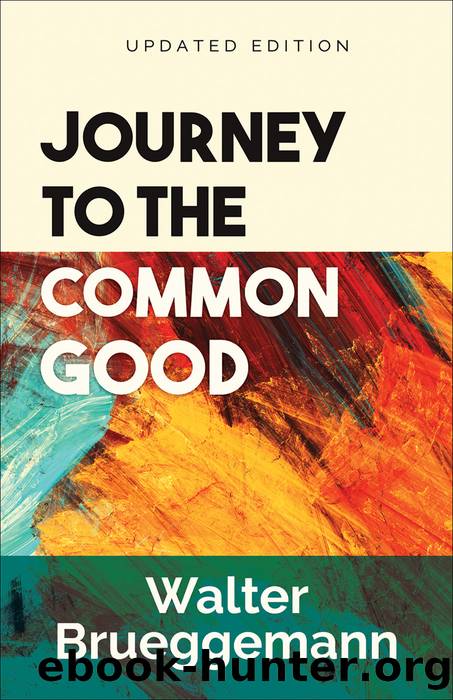
Author:Walter Brueggemann
Language: eng
Format: epub
ISBN: 9781646982011
Publisher: Presbyterian Publishing Corporation
V
Solomon is the model in the Bible for a global perspective of the common good, a perspective that smacks of privilege, entitlement, and exploitation, all in the name of the God of the three-chambered temple, the three chambers that partition social life and social resources into the qualified, the partially qualified, and the disqualified. It takes little critical imagination to see that Solomonâs perspective, which came to dominate urban Israelâs imagination, is an act of resistance against the neighborly demands of Sinai and an alternative to the possibilities of Mount Sinai. It is as though Pharaoh, through his son-in-law, had come to rule in Israel as in Egypt. Jerusalem becomes a place that reenacts Pharaohâs acquisitiveness that is rooted in Pharaohâs anxieties. That perspective of Pharaoh-via-Solomon takes on a powerful life in Jerusalem, largely nullifying the vision of Sinai. In the end, it is as though the exodus had never happened. Or as Moses says, at the end of the book of Deuteronomy in the ultimate covenant curse, it is as though the alternative possibility for Godâs people is to end, yet again, in Egypt:
The LORD will bring you back in ships to Egypt, by a route that I promised you would never see again; and there you shall offer yourselves for sale to your enemies as male and female slaves, but there will be no buyer.
Deut 28:68
Pharaoh always prevails! Except that Sinai continues to have its advocates. The advocates in ancient Israel are not shrill administrators. They are, rather, poets who imagine outside the box, who, by their very lives, attest that the world can be organized differently. You know the roll call of those poets who did not give in to Pharaoh. The list is short!
⢠Nathan, who by way of parable faced Solomonic, pharaonic King David (2 Sam 12:1â5);
⢠Elijah, reckoned as âtroublerâ and âenemyâ in Israel (1 Kgs 18:17; 21:20), who dealt with Solomonic, pharaonic Ahab;
⢠Amos, who grieved a failed society in his confrontation with Solomonic, pharaonic Amaziah (Amos 7:10â17).
The prophets were not great liberals. They were, rather, poets outside the box who were rooted in Sinai, who were gifted with uncommon imagination, and who operated on the astonishing notion that the claims of the exodus God who had created heaven and earth were not easily overcome or dismissed. They were, each in a distinct style and context, convinced that the common good was ill served by Solomonâs chambers of qualification or by pharaonic notions of cheap labor in the interest of a predatory economy.
Download
This site does not store any files on its server. We only index and link to content provided by other sites. Please contact the content providers to delete copyright contents if any and email us, we'll remove relevant links or contents immediately.
The Five People You Meet in Heaven by Mitch Albom(3575)
The Secret Power of Speaking God's Word by Joyce Meyer(3235)
Real Sex by Lauren F. Winner(3027)
Name Book, The: Over 10,000 Names--Their Meanings, Origins, and Spiritual Significance by Astoria Dorothy(2989)
The Holy Spirit by Billy Graham(2961)
0041152001443424520 .pdf by Unknown(2850)
How The Mind Works by Steven Pinker(2821)
ESV Study Bible by Crossway(2782)
Ancient Worlds by Michael Scott(2693)
Churchill by Paul Johnson(2590)
The Meaning of the Library by unknow(2579)
The ESV Study Bible by Crossway Bibles(2554)
The Gnostic Gospels by Pagels Elaine(2537)
MOSES THE EGYPTIAN by Jan Assmann(2419)
Jesus by Paul Johnson(2366)
City of Stairs by Robert Jackson Bennett(2360)
The Complete Dead Sea Scrolls in English (7th Edition) (Penguin Classics) by Geza Vermes(2293)
The Nativity by Geza Vermes(2234)
Ancient Near Eastern Thought and the Old Testament by John H. Walton(2227)
